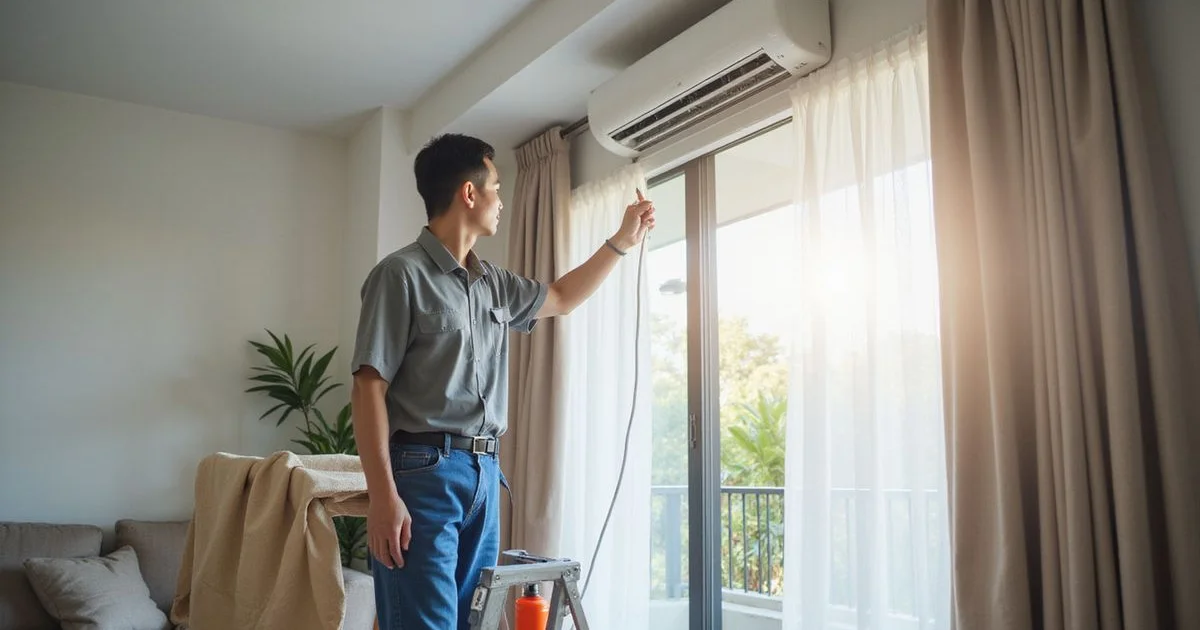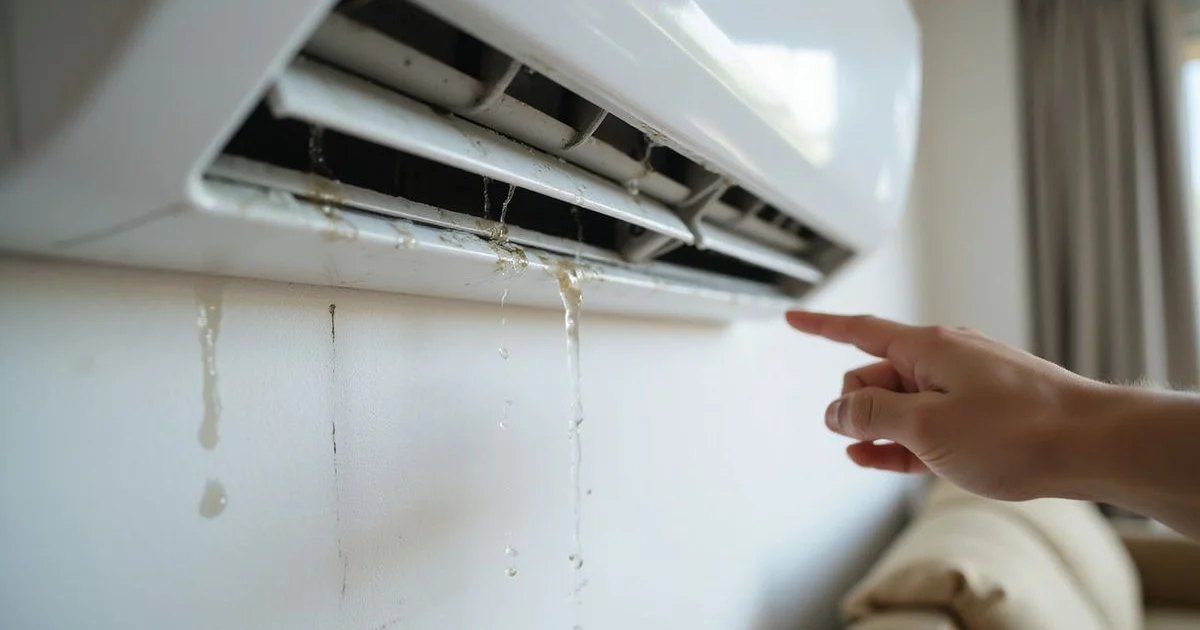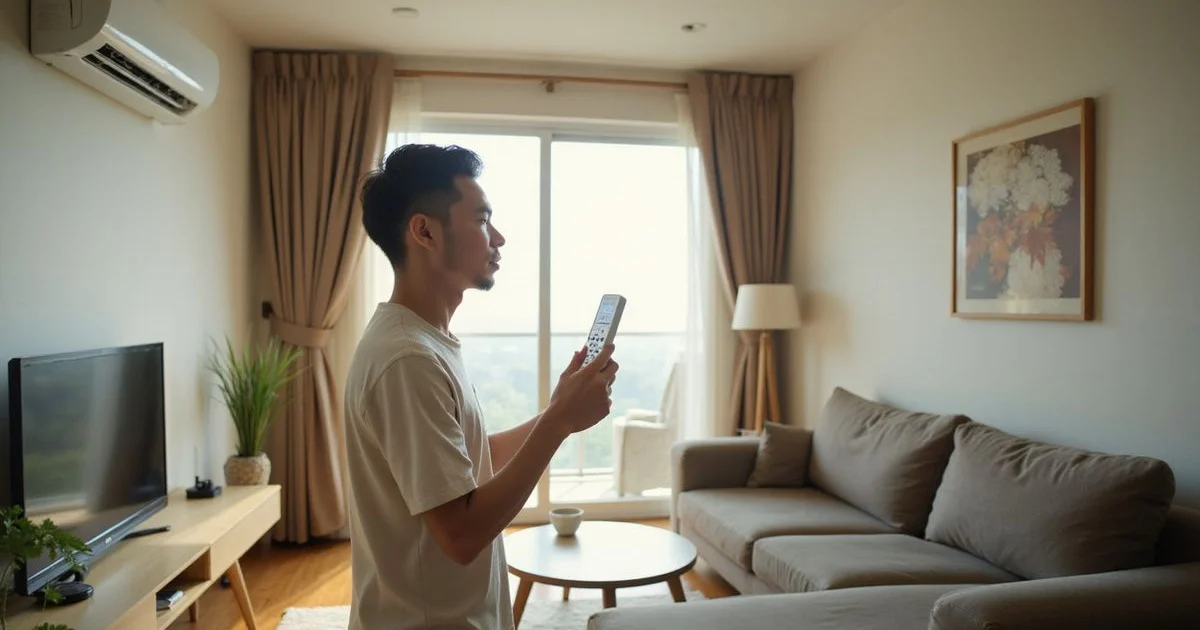
You set your aircond to 18 degrees and the fan is on full blast. The room just will not cool down.
We know exactly how frustrating that feels on a humid Kuala Lumpur night.
The unit is running. You can hear the motor and see the louvres moving.
However, the air coming out feels barely cool or even warm.
This scenario is one of the most frequent complaints our team receives at PJ Kool Aircond Service.
We see this specific issue in about 60% of our emergency service calls.
Most “not cold” issues have identifiable causes that do not require a full system replacement.
Some checks take only minutes to perform yourself.
Other issues usually require a professional diagnosis to ensure safety and efficiency.
We are going to break down the seven most likely reasons your unit is underperforming and how to fix them.
1. Dirty Air Filter
This is the first component our technicians inspect before touching any tools.
A clogged air filter restricts the volume of warm air passing over the evaporator coil.
Without sufficient airflow, the coil cannot absorb heat effectively.
The air coming out of the unit ends up feeling lukewarm as a result.
The Hidden Cost of Dust
We often tell homeowners that a dirty filter hits your wallet twice.
First, it reduces cooling power.
Second, it spikes your energy usage.
Data from energy efficiency studies suggests that replacing a dirty filter with a clean one can lower your air conditioner’s energy consumption by 5% to 15%.
In a place like Petaling Jaya where usage is high, that percentage makes a noticeable difference on your monthly Tenaga Nasional Berhad (TNB) bill.
Quick Check
Open the front panel of your indoor unit and slide out the air filters.
If they are coated with a thick layer of grey dust, you have likely found your problem.
What to Do
Wash the filters under running water and let them dry before reinstalling.
Your aircond should begin cooling noticeably better within 15 to 20 minutes.
We recommend cleaning filters every two weeks in this region.
Malaysia’s high humidity often causes dust to stick more stubbornly than in drier climates.
2. Low Refrigerant (Gas)
Refrigerant is the substance that physically absorbs heat from your room and transfers it outside.
If this level drops, the system loses its capacity to cool.
You might notice the unit blows cool air for ten minutes before turning lukewarm.
Another common sign is ice forming on the copper pipes near the outdoor unit.
Understanding Gas Types in Malaysia
We work with three main types of refrigerant in the Klang Valley.
Knowing which one your unit uses helps you understand the potential costs.
| Refrigerant Type | Status | Efficiency |
|---|---|---|
| R22 | Being phased out (older units) | Low |
| R410A | Standard for units 5-10 years old | High |
| R32 | Current standard (eco-friendly) | Very High |
Why Gas Gets Low
Refrigerant operates in a sealed system and should not deplete on its own.
Low gas almost always indicates a leak.
These leaks typically occur at a pipe joint, flare connection, or due to corrosion in the coil itself.
What to Do
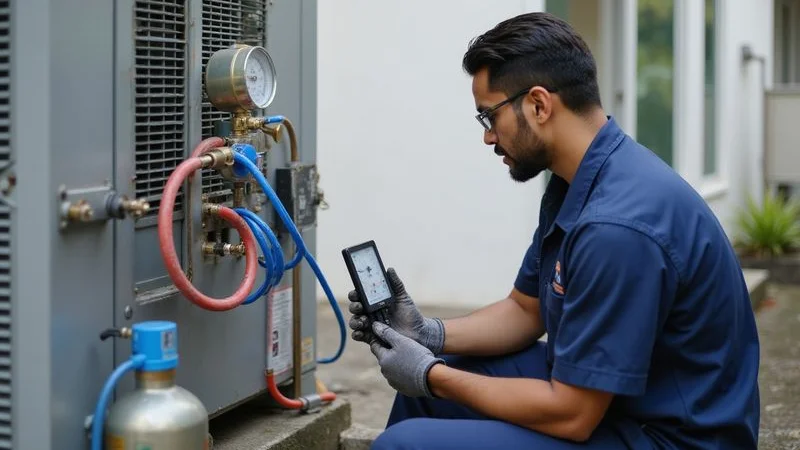
This repair requires professional tools and expertise.
A technician must check the system pressure to locate the leak before topping it up.
Simply adding gas without fixing the leak is a waste of money because it will just leak out again.
At PJ Kool, every chemical wash includes a gas pressure check.
If your unit needs deep cleaning, you can address the leak and the hygiene of the unit in a single visit.
3. Dirty Evaporator Coil
Even if you are diligent about filters, the evaporator coil accumulates grime over time.
Microscopic particles pass through the filter mesh and settle on the wet coil fins.
We find this is especially common in units installed near kitchens or dining areas.
Cooking grease combines with dust to form a sticky “jelly” that traps dirt and creates a thick insulating layer.
This layer prevents the coil from absorbing heat.
The compressor works overtime, but the cooling effect is dramatically reduced.
What to Do
A dirty coil cannot be fixed with standard filter cleaning.
You need a professional chemical wash to dissolve and flush the stubborn buildup.
Standard servicing only wipes the surface.
A chemical wash penetrates deep between the aluminium fins to restore the unit to near-factory efficiency.
4. Faulty Capacitor
The capacitor is a small electrical component that acts like a battery starter for your compressor.
It provides the initial high-voltage jolt needed to start the motor and keeps it running smoothly.
When a capacitor weakens, the compressor might not start at all.
Why Capacitors Fail in KL
We see frequent capacitor failures in older neighborhoods like SS2 or Bangsar.
Heat is the primary enemy of capacitors.
The combination of our tropical weather and the heat generated by the outdoor unit can dry out the fluid inside the capacitor.
Voltage fluctuations, which can happen during thunderstorms, also shorten their lifespan.
Signs of a Faulty Capacitor
- Humming Sound: The outdoor unit hums, but the compressor does not kick in.
- Intermittent Cooling: The air is cold for a while, then suddenly turns warm.
- Hard Starting: The unit shudders violently when trying to turn on.
What to Do
Capacitor replacement is a standard repair for our team.
The cost typically ranges from RM80 to RM150 depending on the microfarad (µF) rating required.
We strongly advise against attempting this yourself.
Capacitors store a lethal electrical charge even when the power is off.
5. Compressor Issue
The compressor is the heart of your aircond system.
It pressurises the refrigerant and circulates it between the indoor and outdoor units.
When this component fails, cooling stops entirely.
Inverter vs. Non-Inverter Compressors
We approach this differently depending on your unit type.
Non-Inverter Units: These run at a fixed speed. Failures are often mechanical or due to a burnt terminal.
Inverter Units: These vary their speed to save energy. Problems here are often related to the electronic board controlling the compressor rather than the pump itself.
Signs of Compressor Problems
- Loud Noises: Grinding or mechanical knocking from the outdoor unit.
- Tripping Breakers: The main fuse box trips immediately when the aircond starts.
- Zero Cooling: The fan runs, but the air is completely room temperature.
What to Do
Compressor replacement is the most expensive repair we encounter.
Costs can range from RM800 to over RM1,500.
However, do not assume the worst immediately.
We have seen many cases where a “compressor failure” diagnosed by others was actually just a RM100 capacitor issue.
Always get a second opinion if the repair quote seems high.
6. Thermostat or PCB Board Problem
The thermostat sensor tells the system what the room temperature is.
If this sensor shifts out of position, it might touch the cold coil.
The unit then “thinks” the room is freezing and shuts off the compressor prematurely.
Similarly, the Printed Circuit Board (PCB) acts as the brain of the operation.
The “Cicak” Factor
We see a unique problem frequently in Malaysian homes involving house lizards (Cicak).
Lizards are attracted to the warmth of the PCB box in the outdoor unit.
They often crawl across the circuit board and cause a short circuit.
This usually fries the board instantly and stops the unit from functioning.
Signs of Electronic Issues
- Short Cycling: The unit runs for three minutes and cuts off.
- Unresponsive Remote: The unit ignores commands or beeps randomly.
- Blinking Lights: The indoor unit timer light flashes in a specific pattern (an error code).
What to Do
Thermostat sensors are a cheap and easy fix.
PCB replacement is more complex and costs between RM200 and RM500.
Our technicians can often repair the existing board rather than replacing it entirely to save you money.
7. Undersized Unit for the Room
This is a design error rather than a mechanical fault.
We see this often in open-concept renovations where walls have been knocked down.
A 1.0HP unit is rated to cool approximately 100 to 150 square feet.
If your space is 250 square feet, that small unit will run continuously without ever reaching the target temperature.
Factors That Increase Cooling Load
- West-Facing Windows: Afternoon sun heats up the walls significantly.
- Top Floor Locations: Heat radiates down from the roof.
- High Ceilings: You are cooling a larger volume of air than the floor plan suggests.
Sizing Guide for Malaysian Homes
If your unit is undersized, the only solution is an upgrade.
Use this guide to check if your current horsepower matches your room size.
| Room Size (sq ft) | Recommended HP | Required BTU/hr |
|---|---|---|
| 100-150 | 1.0 HP | 9,000 - 10,000 |
| 150-250 | 1.5 HP | 12,000 - 13,000 |
| 250-350 | 2.0 HP | 18,000 - 19,000 |
| 350-450 | 2.5 HP | 24,000 - 25,000 |
Quick Checks You Can Do Before Calling a Technician
You can run through a few basic checks before booking a service call.
These steps might save you the cost of a visit.
- Inspect Filters: This solves nearly 30% of the issues we see.
- Verify Remote Mode: Ensure the “snowflake” icon is visible (Cool Mode), not the “water drop” (Dry Mode).
- Clear Outdoor Obstructions: Remove any boxes, dried leaves, or items blocking the outdoor fan.
- Listen Carefully: Note any buzzing or clicking sounds to tell the technician later.
- Reset the Breaker: Turn the aircond switch off and on again at the main board.
It is time to call a professional if these basic steps do not restore cooling.
Our experienced technicians at PJ Kool Aircond Service will diagnose the problem accurately through our professional aircond repair service.
We focus on the most cost-effective solution rather than pushing for expensive part replacements.
Contact us to book a diagnostic visit and get your home cool again.
Mr. Heng
Founder & Lead HVAC Technician
Founder of PJ Kool Aircond Service with 20+ years of HVAC expertise in Petaling Jaya.